Exclusive first look at new animated short: Sang D’Encre

| Shorts | Showcase | 09/11/2012 15:09pm
No Comments

It’s Friday Animation Fun time and once again, students from Bellecour Ecoles d’Art dazzle us with their talents! Take five minutes out of your day to see this cool CG animation

Sang D’Encre is an incredible animated short produced by students at Bellecour Ecoles d’Art. Find out how it was created in this new interview with co-creator Tom Gouill.

Sang D’Encre or Ink Blood was an end of studies short film put together by recent graduates Tom Gouill, Jeoffrey Lavanche and Mélanie Tournois, and very impressive it is too.

Incidentally, these talented people are looking for jobs right now – so you could be the first to snap them up!

Check out Sang D’Encre (Ink Blood) now and then read the interview with Tom below.

“Stylistically speaking, we drew a lot from Tim Burton’s Movies such as Sleepy Hollow, Sweeney Todd or Corpse Bride; also Disney’s Fantasia 2000-Firebird, The Tale of the Three Brothers in Harry Potter and the deathly Hallows part 1, the short Thought of You by Ryan Woodward or the Disney’s video game Epic Mickey (for the Ink)…” says Tom.

3D World: What were the film’s origins?
Tom Gouill: Melanie had the original idea, it was something darker than what we can usually see in student shorts drawing towards Romantic poets like Baudelaire.

Initially, the story was about a poet of the 19th century, who got drunk with absinth, putting himself in a state of melancholia in order to find the inspiration to write, and whose ink muse appears in his soaked dreams.

We finally decided that the story should focus on what writing, inspiration and spleen represent to him. His writing represents all his life, his passion; the short explores what would happen if he lost his inspiration and couldn’t write. To get it back he must sink a little more in his turmoil. It was important for us to show the way he indulges in his misery. With all of this, we kept the idea of a muse made of ink, representing inspiration and writing, to complete our story.

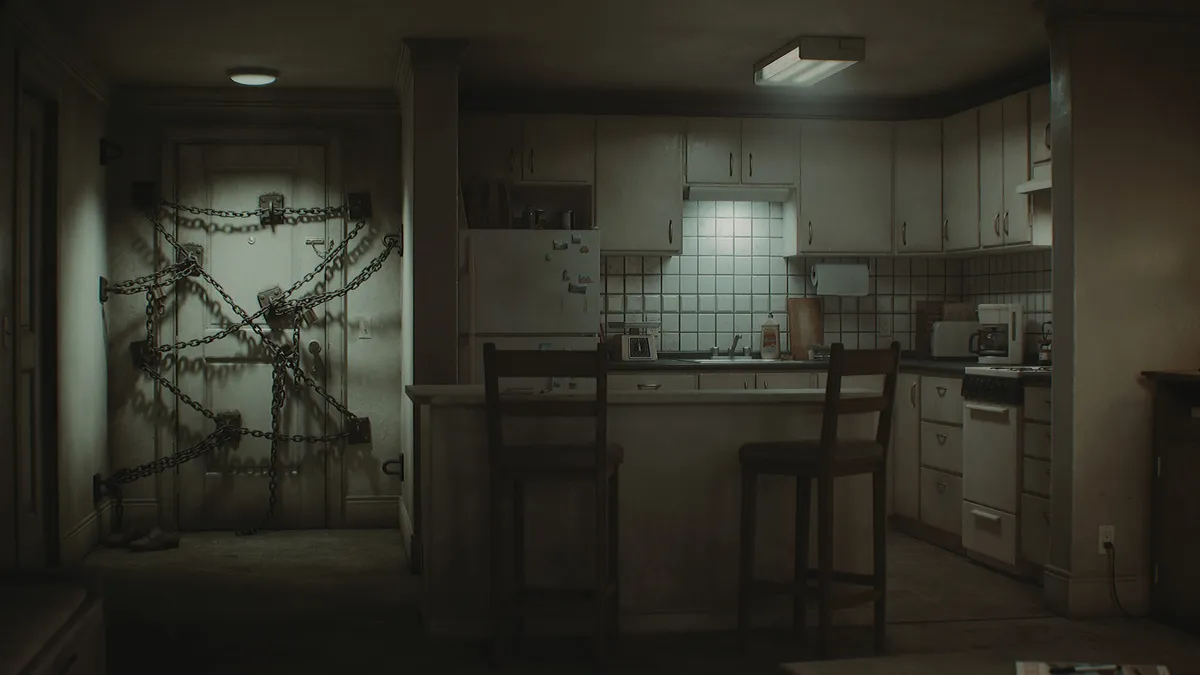
▲ Dark Tim Burton movies and Disney cartoons are just two of Ink Blood's influences...

3D World: What did you do on the short and what was the hardest job?

Actually being only three in the team, allowed each of us to do a lot of different things.

Melanie wrote the original story, which we re-shaped together, she worked on all characters designs, she did the deer, the muse and the dragonfly’s modeling and texturing, and also, the dream’s set dressing and some props. She also skinned the deer and the dragonfly and did some textures. She did layout, animation, lighting rendering and compositing of most of shots in the first part of the room, and finally did the end credits.

▲ The eerie, inky world is beautifully realised with wonderful fluid (slightly sinister) character...

Jeoffrey made props designs, the dream’s environment concept, he did the room’s modeling, he skinned and setuped the main character, re-adapted the animation interface, he also made the first part of the dream’s layout, animation, lighting, rendering and compositing of the first part of the dream and the animation of a few shots of the nightmare.

In my case, I worked on the main character design too, made environment concepts, the story board and 2D layout: at this point of production, we needed a music to base the layout on, so Erwann made us a first rough version of the music.

Then I made the 3D layout of all the nightmare and the end of the movie, the modeling and texturing of the main character, and the fluid simulation.

I was in charge of finding the final look of the movie, so I lit and composited shots for each part of the short, trying to set the different moods and tones for our film.

Then I did the animation, lighting, rendering and compositing of all the shots starting from the nightmare part, and concluded with the editing.
It was the first time that we had made a short movie from start to finish, and we found it hard to keep the narration clear, to keep in mind that what we were doing must serve the story and not blur it.

The fluid simulation in Ink Blood is lovely. The animated short takes a turn to the dark side with the appearance of the mysterious inky character

3D World: What 3D software did you use and why?
We used 3ds Max because it’s the software that we learnt to use in Bellecour Ecoles d’Art during our first two years.

And we used RealFlow for the fluid simulation because it met our expectations.

3D World: What was the most useful piece of 3D software and why?
We used the animation interface made by a friend in our class, Yann Moriaud (who did a loooooooot of things for us! Thanks!)

It enabled us to animate more efficiently after that Jeoffrey re-adapted it for our characters.

▲ The three-strong team took a year to complete Ink Blood

3D World: What was the most impressive technical aspect of the project and how was it achieved using 3D software?
Fluid simulation was the biggest technical challenge of the film, and none of us had ever experienced it.

We chose to use RealFlow. So I learnt to use it gradually making some tests here and there during preproduction time, and I finally made all the ink simulation we needed.

And even if the result is a bit different from what we wanted at first, we didn’t want to base the film on fluid simulation, and on something technical I mean. (The aim was to feel something when you see the movie!)

3D World: Did you learn anything from producing Ink Blood?

I learnt a very important thing, organization is important!

Indeed we lacked rigor on some steps, we went faster upstream, and in return we realized that we spent more time on the steps that followed. But it didn’t harm us that much in the end, we succeeded in keeping a certain balance in the production.

Well, I think we learnt, the three of us, to produce a short film, working as a team, at a professional work rate.

We also learnt that in a production, if you want to respect deadlines, you must set limits and make choices, you can’t always push the quality further, you have to find the good balance.

3D World: Did you use or develop any new or notable techniques?
We used a script library created by Yann Moriaud and Jules Pinhede, which contains a lot of very useful scripts, like for instance one which turned on all computers in a clic or turn on/off every meshmooth in a 3D scene.

Otherwise, we used a featured-film technique for rendering, we rendered each light in one pass. This technique demanded more time and organization, but it gave us a lot of freedom for the compositing.

3D World: What’s next for you?
Well, we are currently looking for job opportunities, the three of us. [Ed: You hear that, all studios and recruiters out there?]

3D World: Your short is not only a great story, but technically brilliant – where do you hope it will take you?
Firstly, thank you! Well, we hope it will have a great and long life, whether it is in festivals or on the web; but also that it will allow us to find jobs.

Thanks to Tom Gouill for giving us this interview. All the best to you and the team!

More cool animated shorts

If you liked this, you may like to see the following animations…

Monsterbox is a gorgeous animated short produced by four graduates from Bellecour Ecoles d’Art… Take five minutes out of your day to watch the film. You won’t be disappointed…

And there’s the masterful student short, A Fox Tale, too!

The creators of A Fox Tale also provide some useful insights into character design in issue 161 of 3D World.


Posted on Friday, November 9th, 2012 at 3:09 pm under Shorts, Showcase. You can subscribe to comments. You can leave a comment, or trackback from your own site.

Tags: , , , ,

Share This Page